
Every day is Earth Day on the Farm. It’s not just a 24-hour pause to remember and honor the Earth. Earth Day on the Farm is more like Easter. It’s an annual celebration of a long-term commitment to “everlasting” life.
Just imagine spending all day outside, earning a living in a working landscape. That may sound pretty idyllic if you’re an avid hiker, hunter, biker, or bird watcher trapped in a cubical in a high-rise office building in the middle of a polluted urban area. But, there’s also a tough reality to Earth Day on the Farm.
Now imagine spending all of the daylight hours outside, dealing with the aftermath of the latest bomb cyclone in the dead of winter or in the heat of high summer. Or, imagine lying awake all night worrying about how to support your family when market prices are down and input expenses are high.
The secret to celebrating Earth Day on the Farm is to work WITH Nature rather than struggling against Nature. A perceived fight to survive often leads to extractive management practices that deplete soil, pollute water, endanger animals, and gut communities. But, these are mainly driven by the greed and hubris of large, indifferent corporations and their executives who live in gated isolation. In contrast, my neighbors and the vast majority of family farmers living on the land are fully engaged and humble stewards who clearly understand the fundamental economic imperatives of working with Nature.
In 1970 my family completely missed out on the first Earth Day celebration because we were waiting for my brother’s body to return home from Viet Nam. In 2018 I wrote an essay for a conference on how the war influenced life in the Great Plains. Here’s a link to the “story” version that I read at the conference: https://ellsbrothers.wordpress.com/2018/04/19/the-story-of-how-the-vietnam-war-impacted-a-family-farm-in-the-eastern-great-plains/ But, beware it’s about 4,000 words. And, here’s a link to the full essay (7,000 words) with references included: https://retiredprofessorramblings.wordpress.com/2018/04/18/suspended-succession-how-the-vietnam-war-impacted-a-family-farm-in-the-eastern-great-plains/
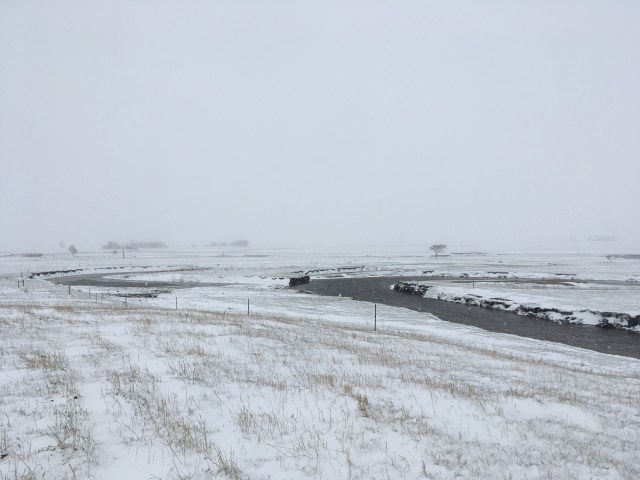

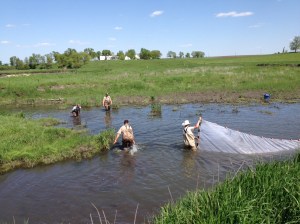
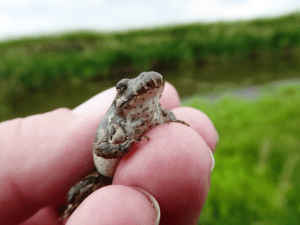
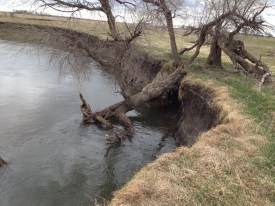
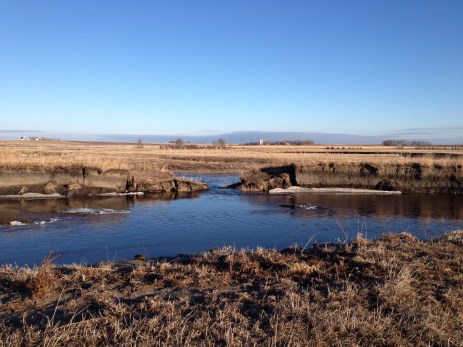
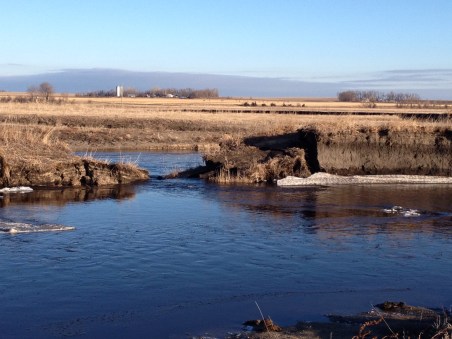
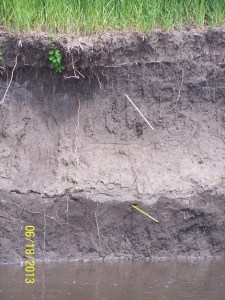 In 2012 the Minnesota Department of Natural Resources started annual surveys of the multiple meander loops that eventually cut off to form our oxbow and wetland. Part of that data collection included driving “pins” about 4 feet long into the high bank. Every year the exposed pins were measured to give estimates of erosion rates as high as several feet per year.
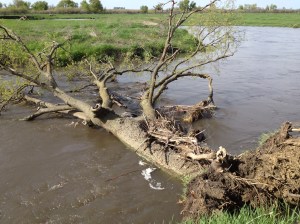 Here’s another tree that recently fell into the eroding channel. But, this one is special. It’s located at the base of the bluff just north of our house and was a place where magical staffs and other treasures have been stored because it was hollow. Now instead of storage it may become a bridge across the Creek until it gets swept away in the next flood.
 Great-grandma Hannah Cackett Shurr was born in Wales, raised in upstate New York, and came to the farm as a homesteader in the early 1870s. The family legend is that when they arrived with their young family, the house that was supposed to be waiting for them was not built. Great-grandpa John was deeply disturbed and wanted to turn around and go back to Waseca, MN, where they had farmed for several years. But, Hannah would have none of that. They stayed and set up housekeeping in a dugout near the Lone Tree. Her tree is the cottonwood.
 on a farm north of Ellsworth. She was 100% Irish and when her parents moved to town, they sold the farm to the man who would eventually become Grammy Margaret’s great-grandfather. There’s a family tradition that when Daisy came to Lone Tree Farm as Grandpa George’s bride in 1904, she planted several lines of lilacs. Her new father-in-law was convinced that they wouldn’t grow, but Daisy carried water to them. The bushes survived and are still vibrant after more than a century. Her iconic tree is the lilac.
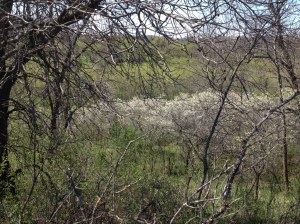 Grandma Bernita Bell Shurr was born “on the backs of Plum Creek” near Walnut Grove, MN. She married Grandpa John and moved to the banks of Kanaranzi Creek in 1940. She loved Nature and the family story goes that she would sneak down to the Creek to sit on at the top of a steep bank and watch her two boys playing in the water. Her sons never knew that she watched over them. Her symbolic tree is the wild plum.
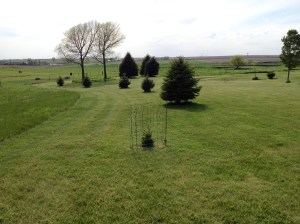 German and married Papa George in part because she was related to all of the other boys in her neighborhood. When they lived in St. Cloud, MN, Grammy planted many different kinds of trees and she planted a lot of them. Although she continued to plant trees after they moved to Lone Tree Farm in 1998, there is one type that she particularly likes. Grammy’s favorite tree is the evergreen.
 This big boulder “magically” appeared alongside the Kanaranzi this spring. The pocket knife shows the size. This big guy is about 3 ft by 1.5 ft and is about 1 ft thick.
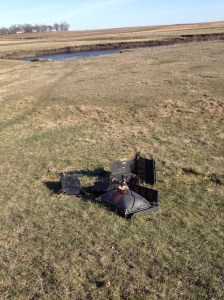 We thought that someone had dumped it there two years ago, but the story is more complicated. Neighbors have told us that it was originally upstream in the thicket of trees locally known as the Jungle. That’s about a mile away up the valley near the Rainbow Curve.
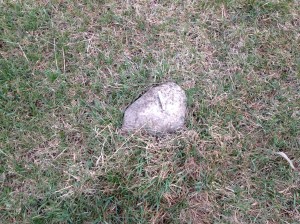 This smaller boulder has the explanation. Several years ago I saw this rock perched on top of big ice slab. The raft had landed at some distance back from the channel after the spring flood and it deposited its load after the ice slab melted.
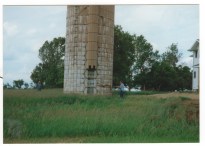
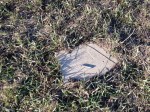
 This door is all that’s left of the silo on Lone Tree Farm.
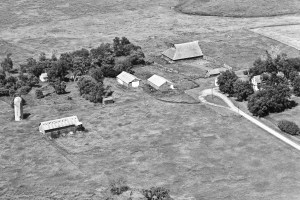
 Here’s a photo that Mom took in the early 1970’s.

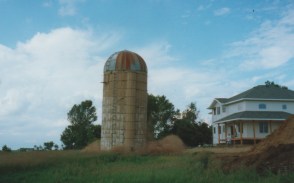





 Lone Tree Farm on Kanaranzi Creek